
Archively Research Note 01
Figure 1 of 4, from When Does an AI Proposal Become Archival Description?, placed in section 4, The institutional acceptance boundary.
Figure 1
The institutional acceptance boundary
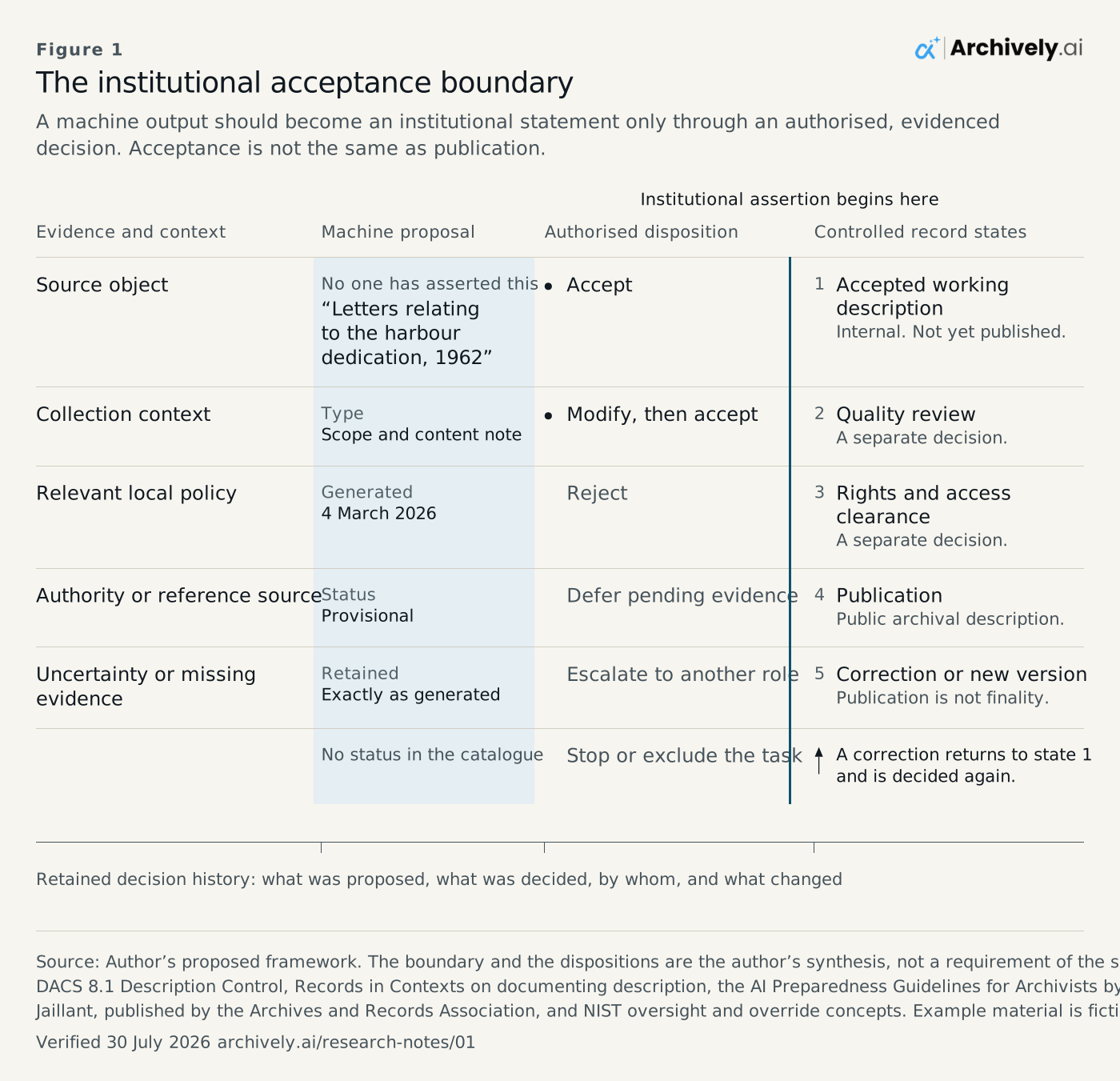
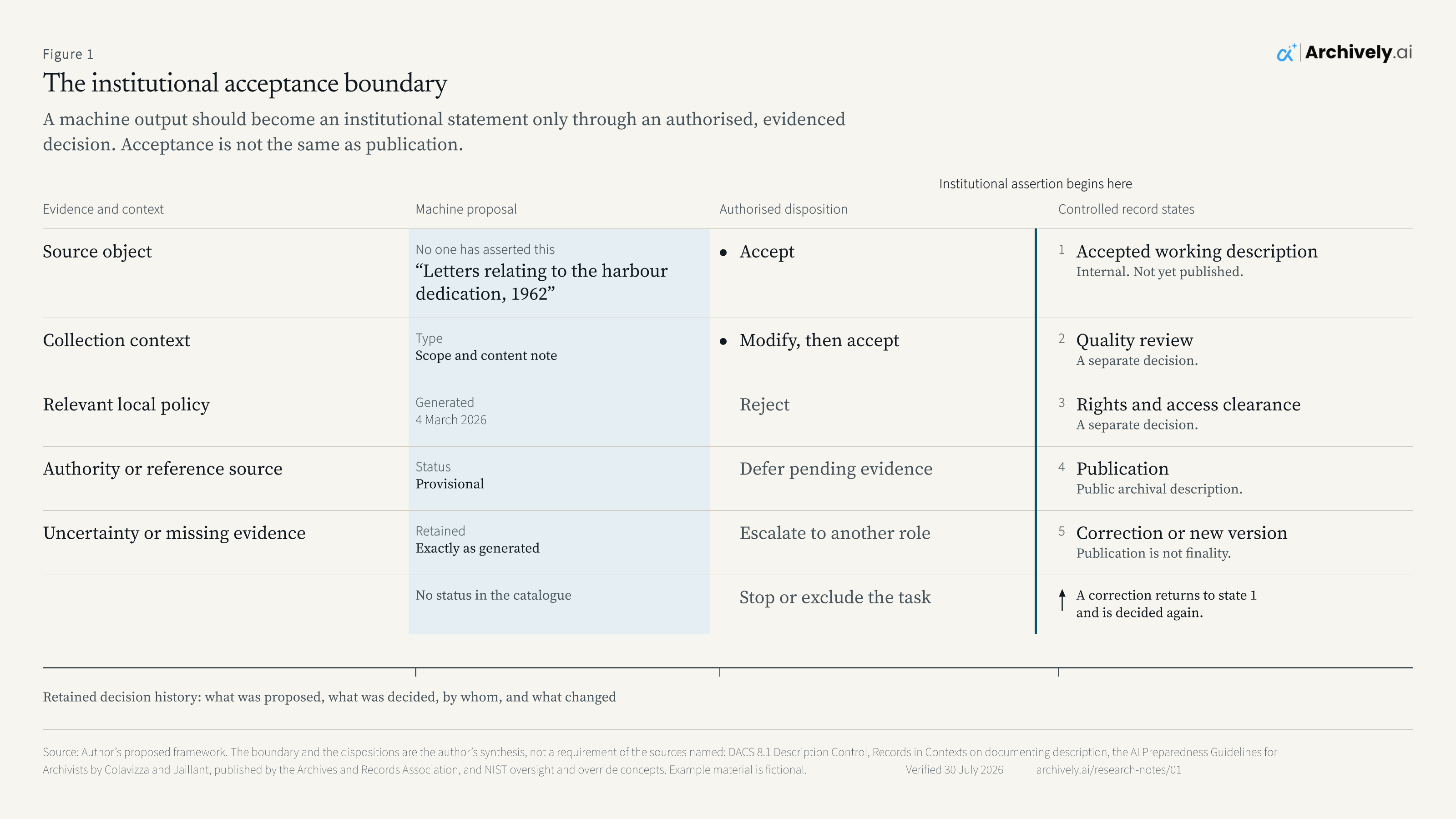
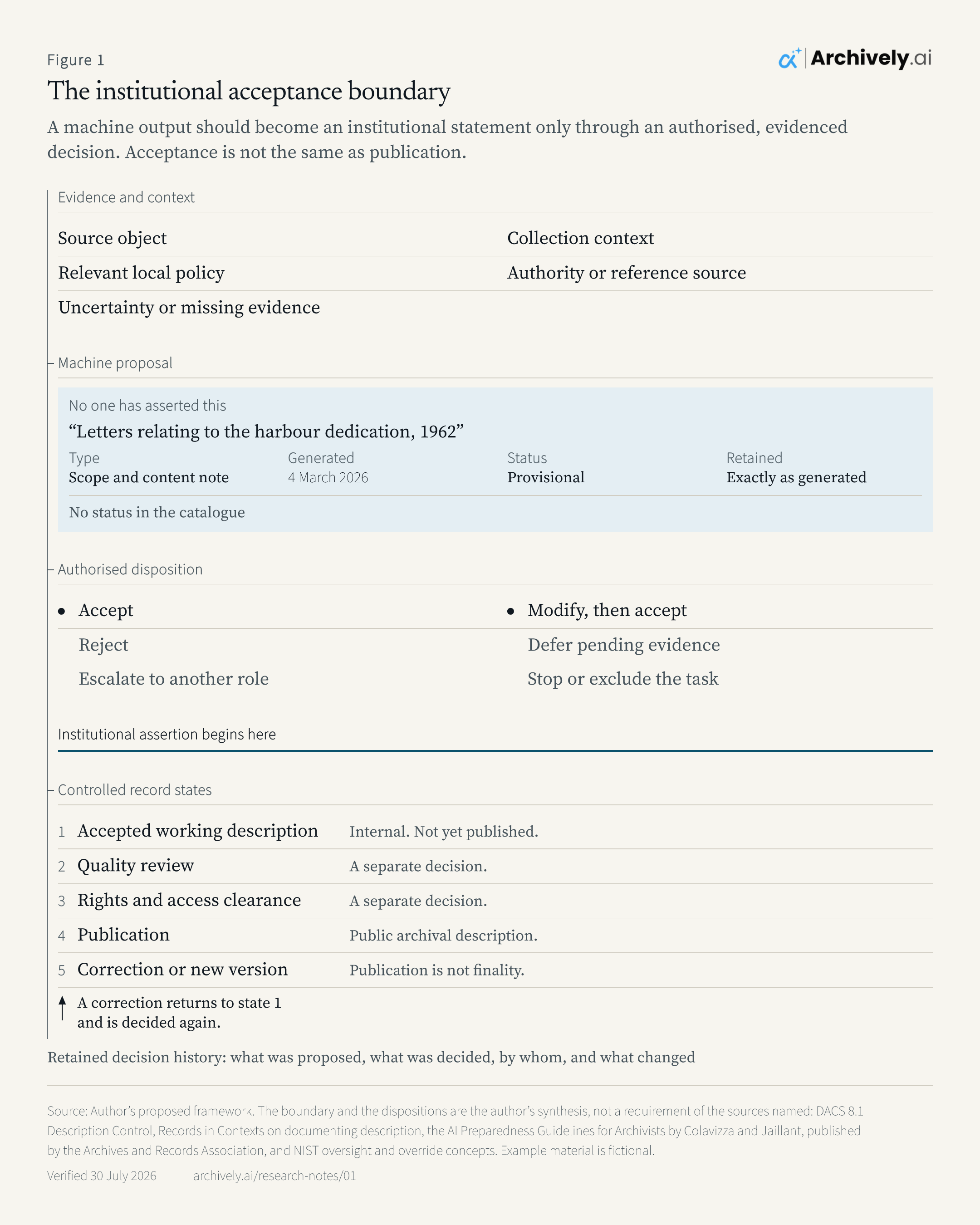
A machine output should become an institutional statement only through an authorised, evidenced decision. Acceptance is not the same as publication.
A single review gate folds two different decisions into one. Separating them is the author’s proposal, and it makes four distinctions visible: a proposal is not description, acceptance is not publication, quality review and rights clearance are distinct decisions, and publication is not finality.
Example material is fictional
Author’s proposed framework. The boundary and the dispositions are the author’s synthesis, not a requirement of the sources named: DACS 8.1 Description Control, Records in Contexts on documenting description, the AI Preparedness Guidelines for Archivists by Colavizza and Jaillant, published by the Archives and Records Association, and NIST oversight and override concepts.
Last verified
Figure files:SVGPNG 16:9PNG 4:5
Text version:Read Figure 1 as text
Four groups of type, read in order, ruled like a printed table and with no boxes and no connecting arrows: the hairlines that separate the entries run the full width of the plate, so no group keeps a rhythm of its own. Group one, evidence and context, lists source object, collection context, relevant local policy, authority or reference source, and uncertainty or missing evidence, and then stops. Group two, machine proposal, is the only tinted region in the figure: it opens with the line no one has asserted this, then a proposed scope and content note reading letters relating to the harbour dedication, 1962, then one field to a line for its type, a generation date of 4 March 2026, a provisional status and a note that it is retained exactly as generated, and finally a closing line saying it has no status in the catalogue. Group three, authorised disposition, lists six outcomes. Accept and modify then accept come first, in full ink, each with a small filled circle beside it, above a hairline. Below that hairline, in lighter ink and with no circle, sit reject, defer pending evidence, escalate to another role, and stop or exclude the task. A single heavy rule, labelled institutional assertion begins here, separates the dispositions from the fourth group and crosses every hairline it meets. Group four, controlled record states, is numbered one to five: accepted working description, internal and not yet published; quality review, a separate decision; rights and access clearance, a separate decision; publication, public archival description; and correction or new version, publication is not finality. Below the hairline that closes the fifth state, a sixth entry carries no number: in place of one there is a short upright arrow with a solid head pointing back up the column of numbers, and beside it, set horizontally in full ink, the line a correction returns to state 1 and is decided again. That return is the only movement against the reading order in the figure: a correction does not bypass the heavy rule, it goes back to the accepted working description and through the same decisions a second time. A retained decision history rule carries tick marks at the machine proposal, the authorised disposition and the record states, and reads: what was proposed, what was decided, by whom, and what changed.
The figure sets out four stages in order. A bold rule falls between the third stage and the fourth. Everything before the rule is a proposal and a decision about it. Everything after the rule is an institutional statement.
- Evidence and context. Source object; Collection context; Relevant local policy; Authority or reference source; Uncertainty or missing evidence.
- Machine proposal. No one has asserted the proposal. It is retained exactly as generated, with its type, generation date and provisional status, and it has no status in the catalogue.
- Authorised disposition. Six outcomes are available: accept; modify, then accept; reject; defer pending evidence; escalate to another role; stop or exclude the task. Only accept and modify-then-accept cross the rule. The other four return the task without producing an institutional statement.
- Controlled record states. 1. Accepted working description (Internal. Not yet published.) 2. Quality review (A separate decision.) 3. Rights and access clearance (A separate decision.) 4. Publication (Public archival description.) 5. Correction or new version (Publication is not finality.) Below the fifth state, a short arrow points back up the numbering beside the line: A correction returns to state 1 and is decided again. That return is the one movement against the order of the four stages.
A retained decision history covers stages two to four, recording what was proposed, what was decided, by whom, and what changed.