
Archively Research Note 01
Figure 2 of 4, from When Does an AI Proposal Become Archival Description?, placed in section 5, Six proposed conditions for meaningful review.
Figure 2
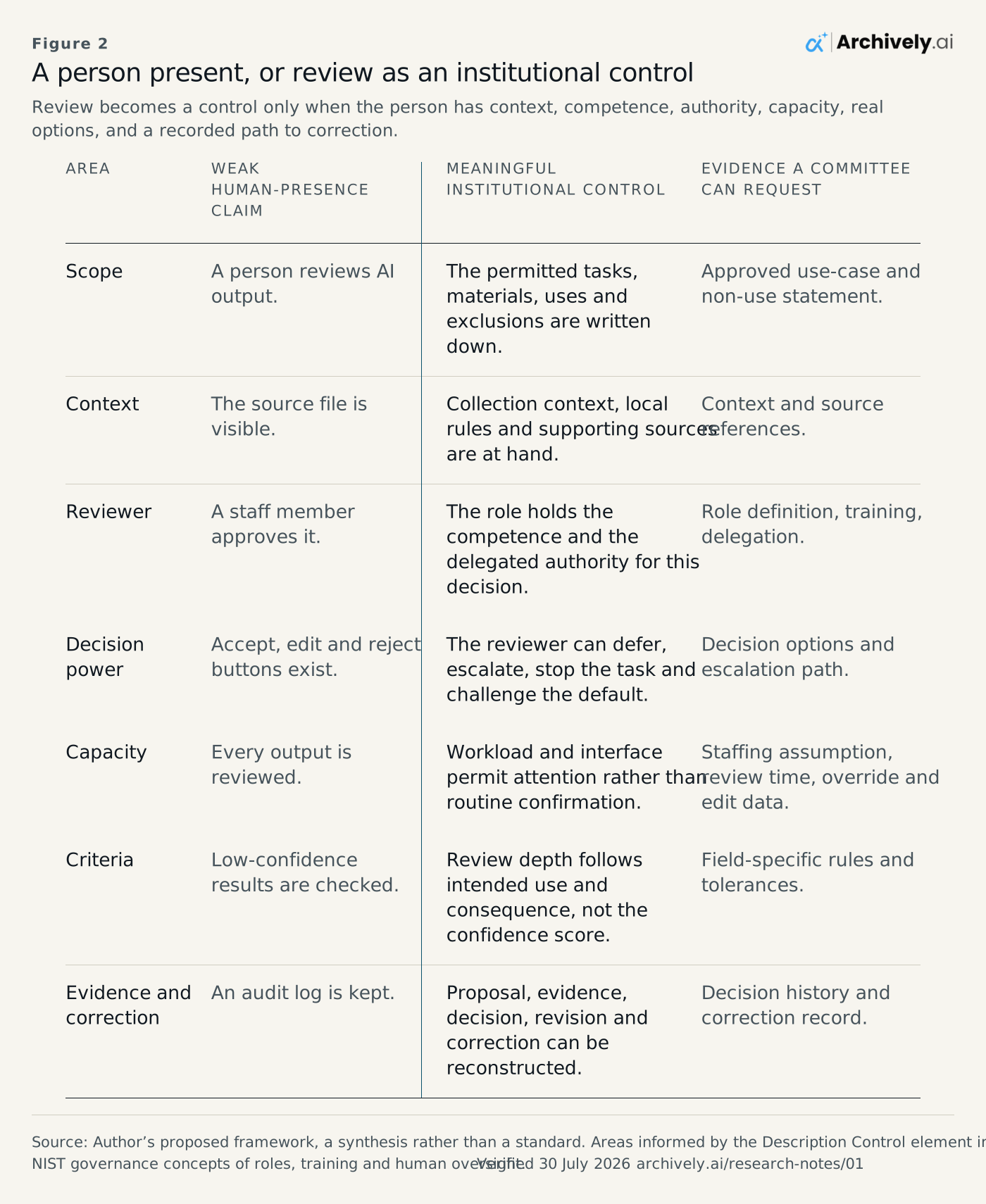
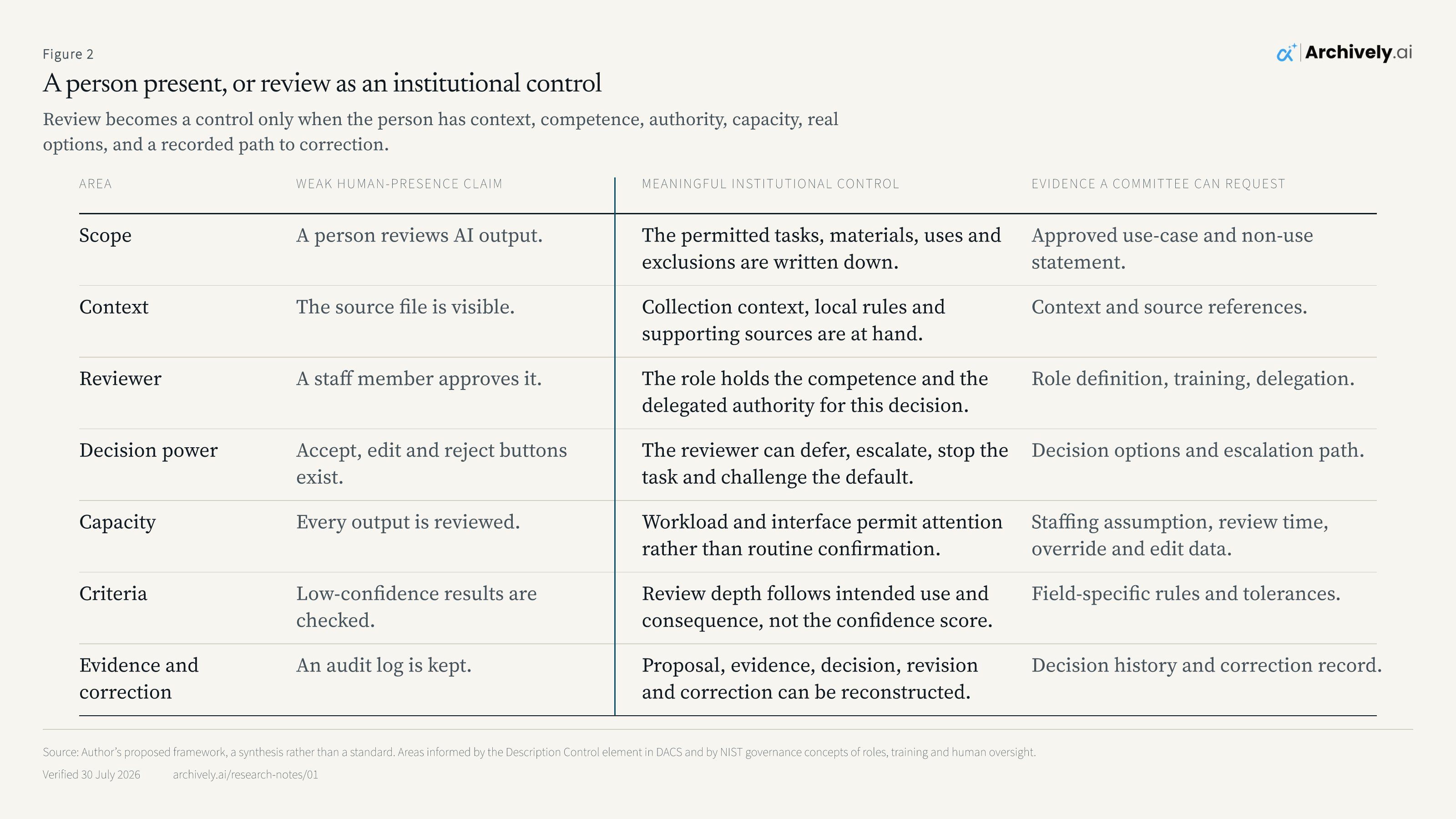
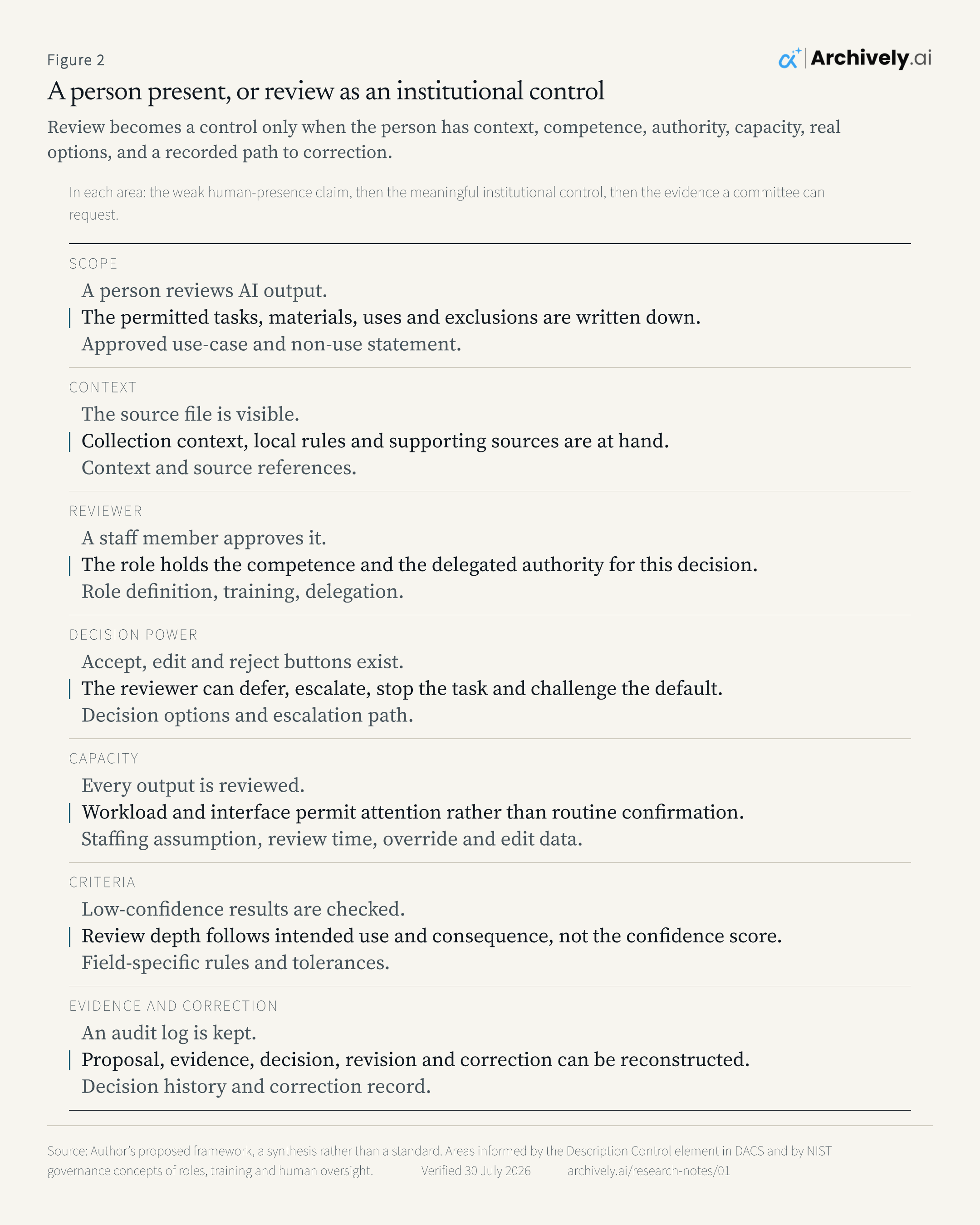
A person present, or review as an institutional control
| Area | Weak human-presence claim | Meaningful institutional control | Evidence a committee can request |
|---|---|---|---|
| Scope | A person reviews AI output. | The permitted tasks, materials, uses and exclusions are written down. | Approved use-case and non-use statement. |
| Context | The source file is visible. | Collection context, local rules and supporting sources are at hand. | Context and source references. |
| Reviewer | A staff member approves it. | The role holds the competence and the delegated authority for this decision. | Role definition, training, delegation. |
| Decision power | Accept, edit and reject buttons exist. | The reviewer can defer, escalate, stop the task and challenge the default. | Decision options and escalation path. |
| Capacity | Every output is reviewed. | Workload and interface permit attention rather than routine confirmation. | Staffing assumption, review time, override and edit data. |
| Criteria | Low-confidence results are checked. | Review depth follows intended use and consequence, not the confidence score. | Field-specific rules and tolerances. |
| Evidence and correction | An audit log is kept. | Proposal, evidence, decision, revision and correction can be reconstructed. | Decision history and correction record. |
Review becomes a control only when the person has context, competence, authority, capacity, real options, and a recorded path to correction.
Seven areas where the phrase “human in the loop” is usually doing more work than the arrangement behind it. The middle column is the claim worth making. The right column is what a director or a procurement committee can ask to see, which is the difference between a claim and a control.
Author’s proposed framework, a synthesis rather than a standard. Areas informed by the Description Control element in DACS and by NIST governance concepts of roles, training and human oversight.
Last verified
Figure files:SVGPNG 16:9PNG 4:5
Text version:Read Figure 2 as text
A seven-row comparison table. For each of scope, context, reviewer, decision power, capacity, criteria, and evidence and correction, three fields give a weak human-presence claim, the meaningful institutional control that replaces it, and the evidence a committee can request. One rule marks where the comparison turns, between the weak claim and the meaningful control, which is the comparison the figure is making. For example, under decision power, the weak claim is that accept, edit and reject buttons exist; the meaningful control is that the reviewer can defer, escalate, stop the task and challenge the default; and the evidence is the documented decision options and escalation path. The full table is reproduced in the page as markup.
| Area | Weak human-presence claim | Meaningful institutional control | Evidence a committee can request |
|---|---|---|---|
| Scope | A person reviews AI output. | The permitted tasks, materials, uses and exclusions are written down. | Approved use-case and non-use statement. |
| Context | The source file is visible. | Collection context, local rules and supporting sources are at hand. | Context and source references. |
| Reviewer | A staff member approves it. | The role holds the competence and the delegated authority for this decision. | Role definition, training, delegation. |
| Decision power | Accept, edit and reject buttons exist. | The reviewer can defer, escalate, stop the task and challenge the default. | Decision options and escalation path. |
| Capacity | Every output is reviewed. | Workload and interface permit attention rather than routine confirmation. | Staffing assumption, review time, override and edit data. |
| Criteria | Low-confidence results are checked. | Review depth follows intended use and consequence, not the confidence score. | Field-specific rules and tolerances. |
| Evidence and correction | An audit log is kept. | Proposal, evidence, decision, revision and correction can be reconstructed. | Decision history and correction record. |