

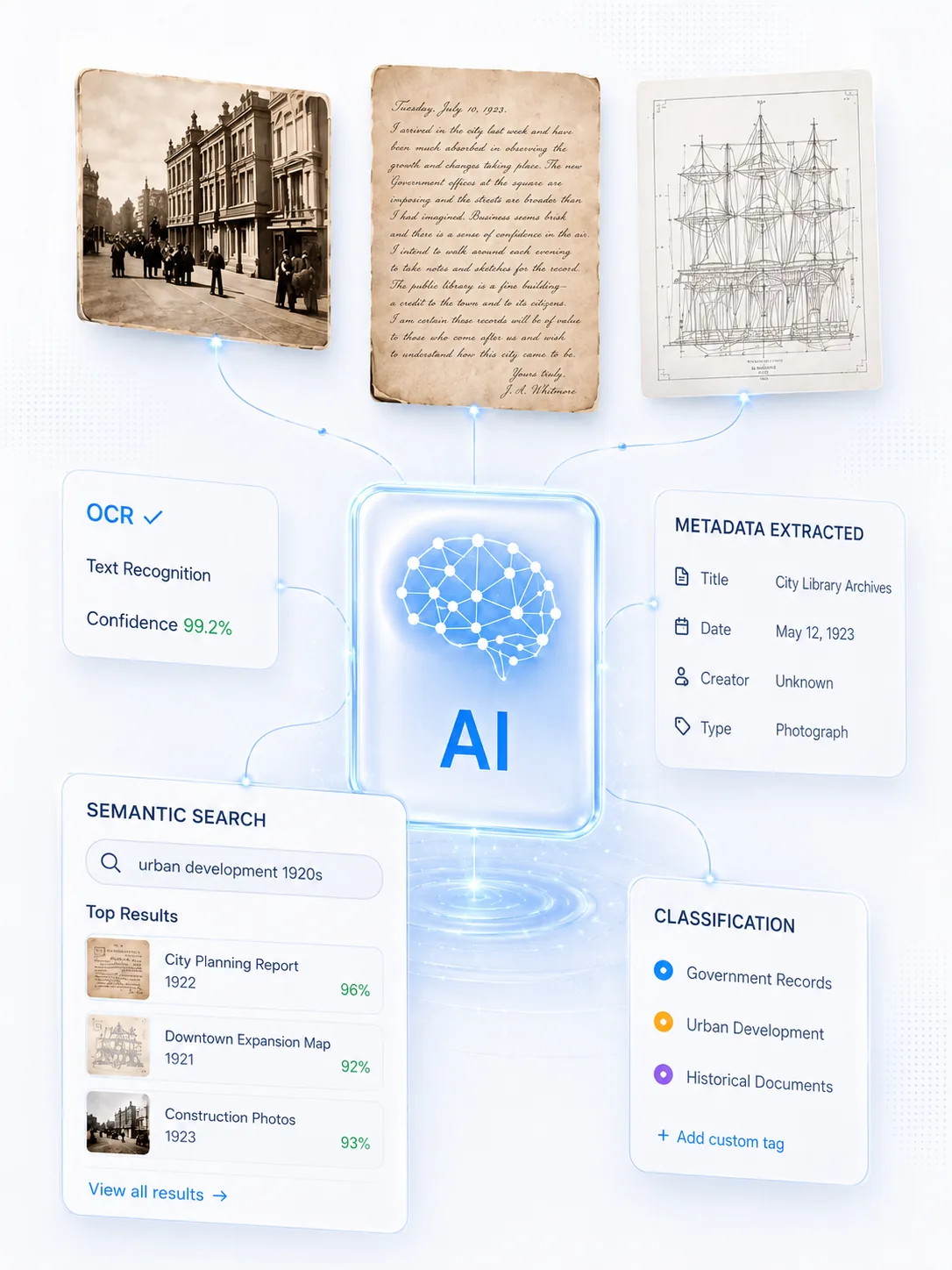
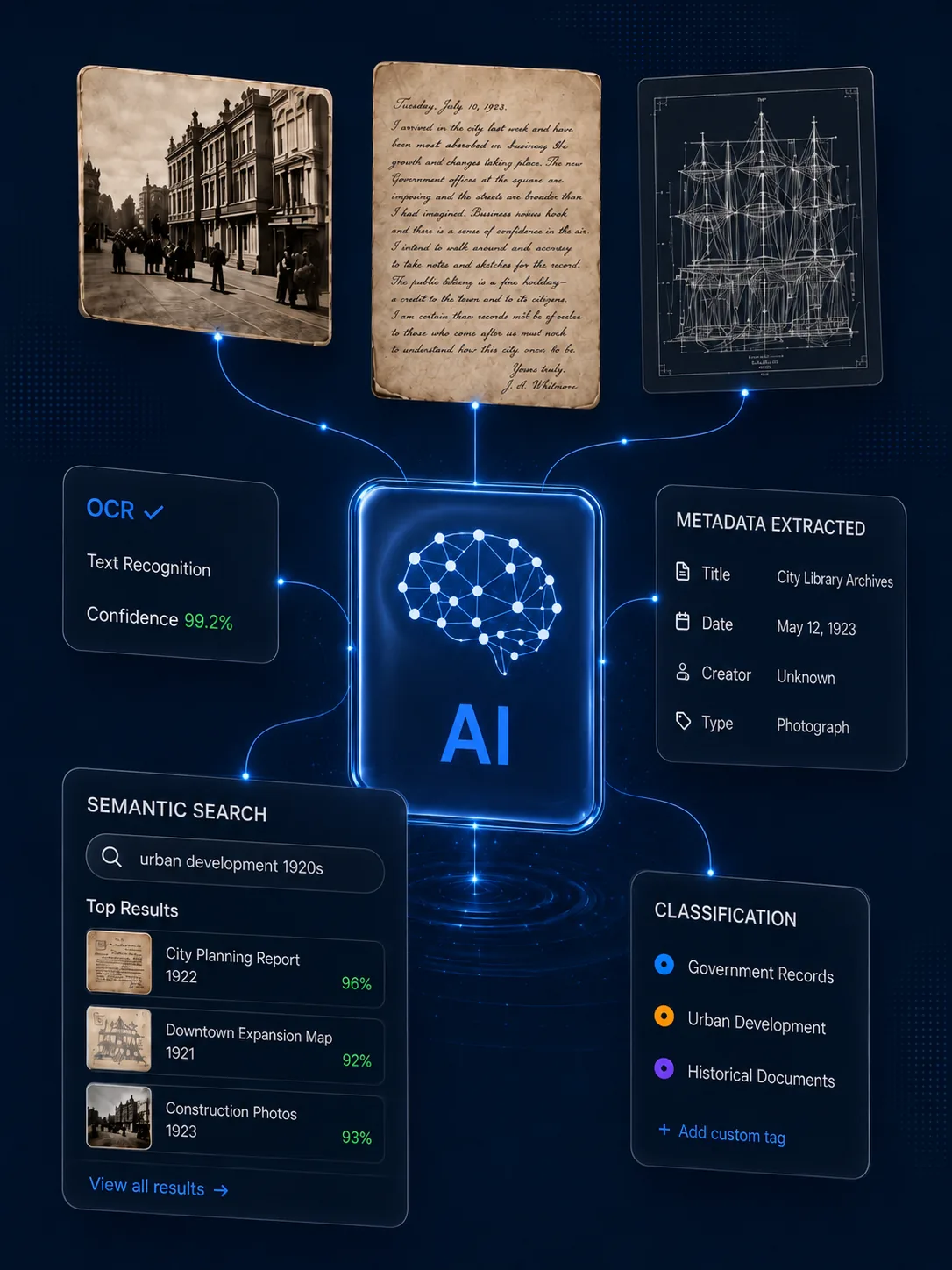
The archive your institution deserves — cataloged by AI, curated by you.
A modern platform for libraries, universities, and government archives. Upload anything, let AI draft the description, and publish to international standards — without leaving your workflow.
- 7
- Catalog modules
- 7
- Standards
- 30+
- File types


A working surface built around the catalog record.
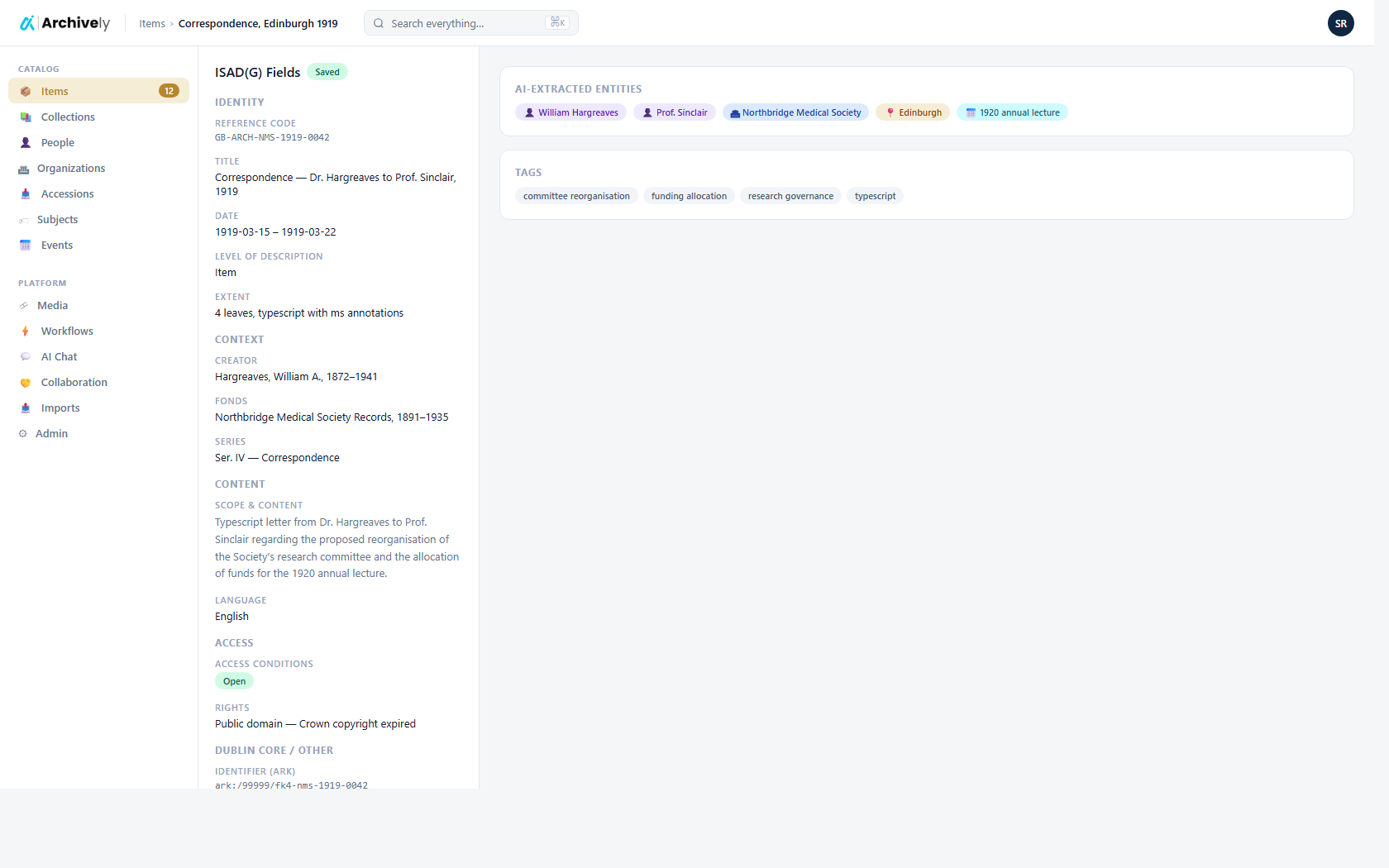
Not a wiki, not a spreadsheet. Every item is a live document with AI-drafted fields on one side, the source on the other, and a persistent track-changes bar so nothing ships without curator sign-off.
- AI badge shows which fields were drafted by the model
- Scope & content, creator, dates, and subjects shown inline
- Save / revert bar tracks unsaved edits across tabs
- One-click publish locks an immutable snapshot

Ask
items I edited this week
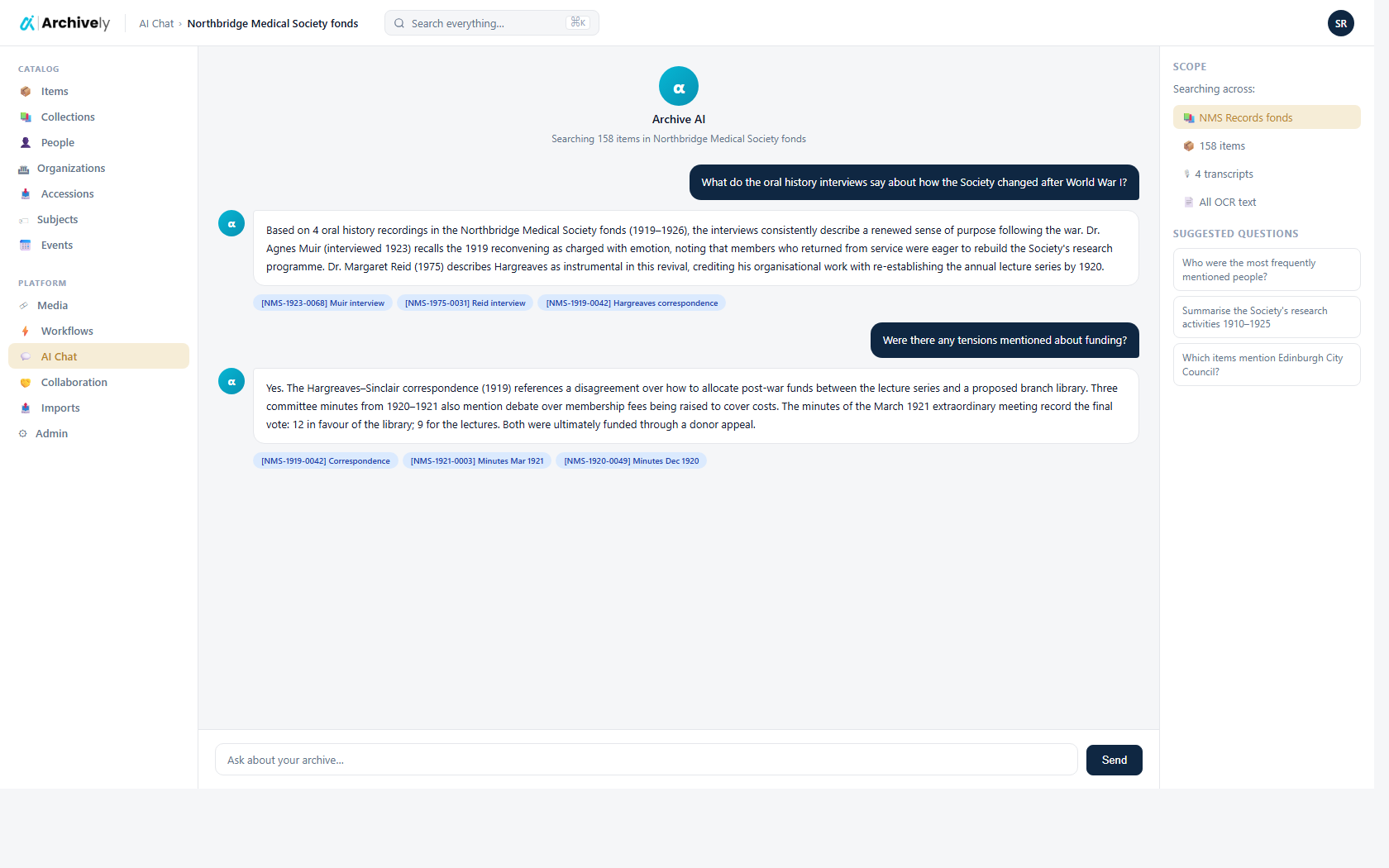
Find anything by just asking.
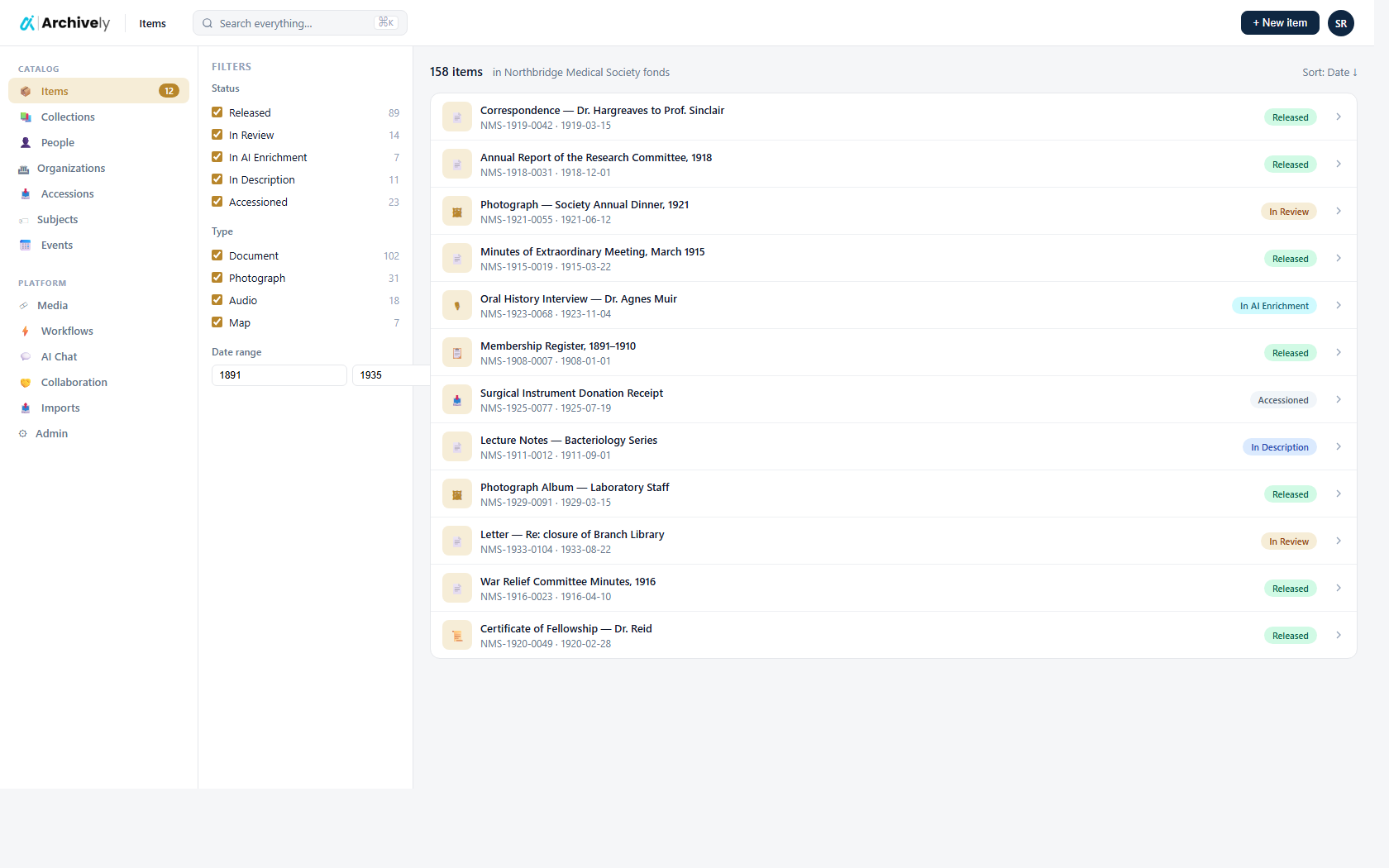
A floating prompt bubble lets curators query the catalog in their own words. Items I edited this week. Fonds from the 1920s. Drafts ready for review. Each result jumps straight to the matching record. Recent prompts are remembered so routine queries are one click away.
- Works across every catalog module — items, fonds, people, organizations, accessions, subjects, events
- Server-validated filters — the AI translates, the catalog enforces
- Click-to-open — results land in the matching detail tab
Six tools, retired. One platform, instead.
Most archives run on a stack: a DAM, an OCR vendor, cataloging software, a transcription service, an image editor, and whatever publishes the finding aid. Archively.AI replaces the lot — one platform, one standards-compliant data model, one place curators work.
Every file type, one viewer.
Images, PDFs, audio, video, spreadsheets, Office — each gets the right preview and the right pipeline. No second tool to license, no separate ingest path.
OCR runs inside the upload.
Native text extraction for born-digital PDFs, Textract for scanned pages — both in the same workflow, with every word track-changed before it ships to the catalog.
A standards-shaped catalog.
ISAD(G), Dublin Core, MARC21, PREMIS — mapped to the data model, not bolted on as an export. Seven catalog modules, every record search-faceted out of the box.
Audio and video, transcribed inline.
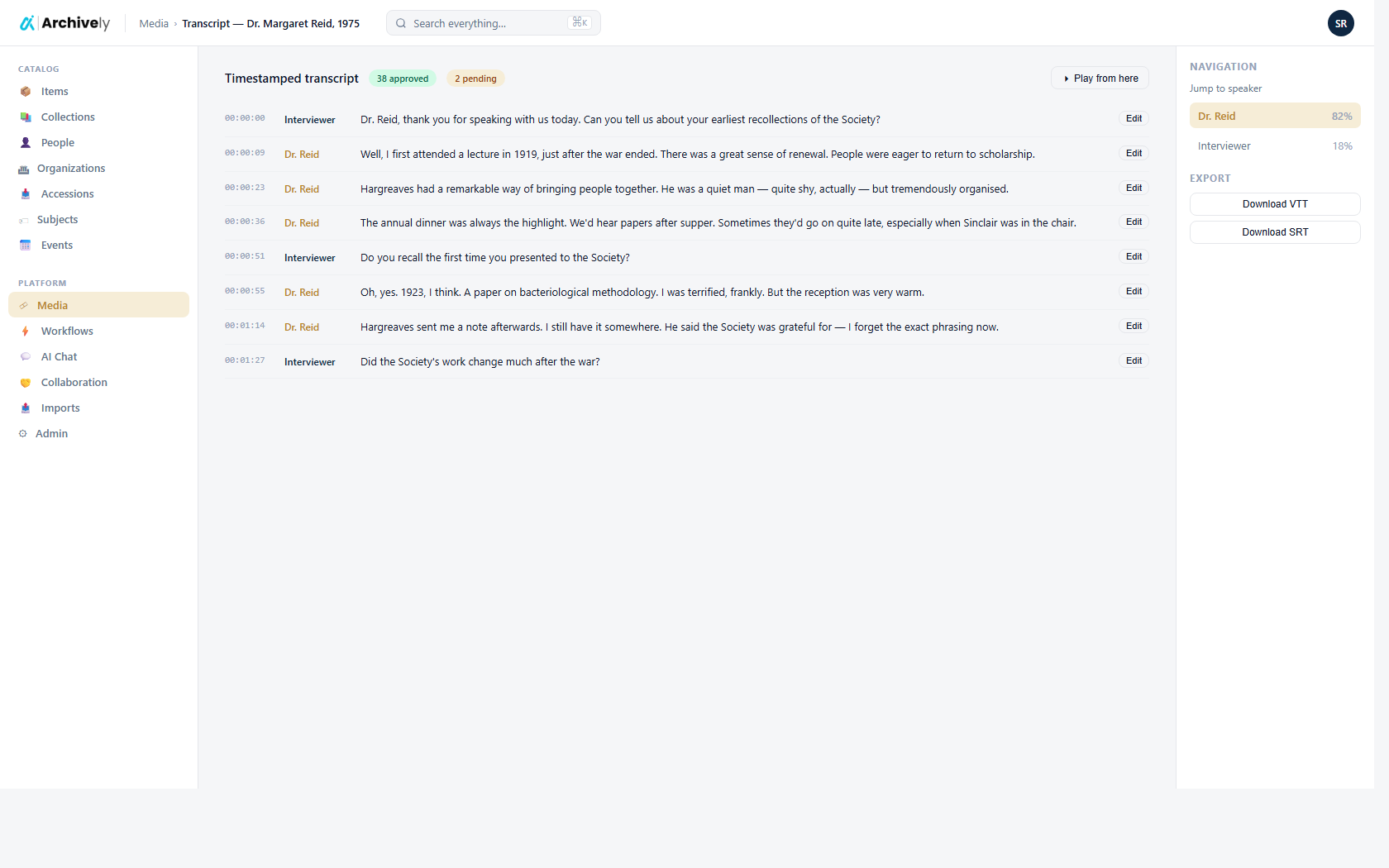
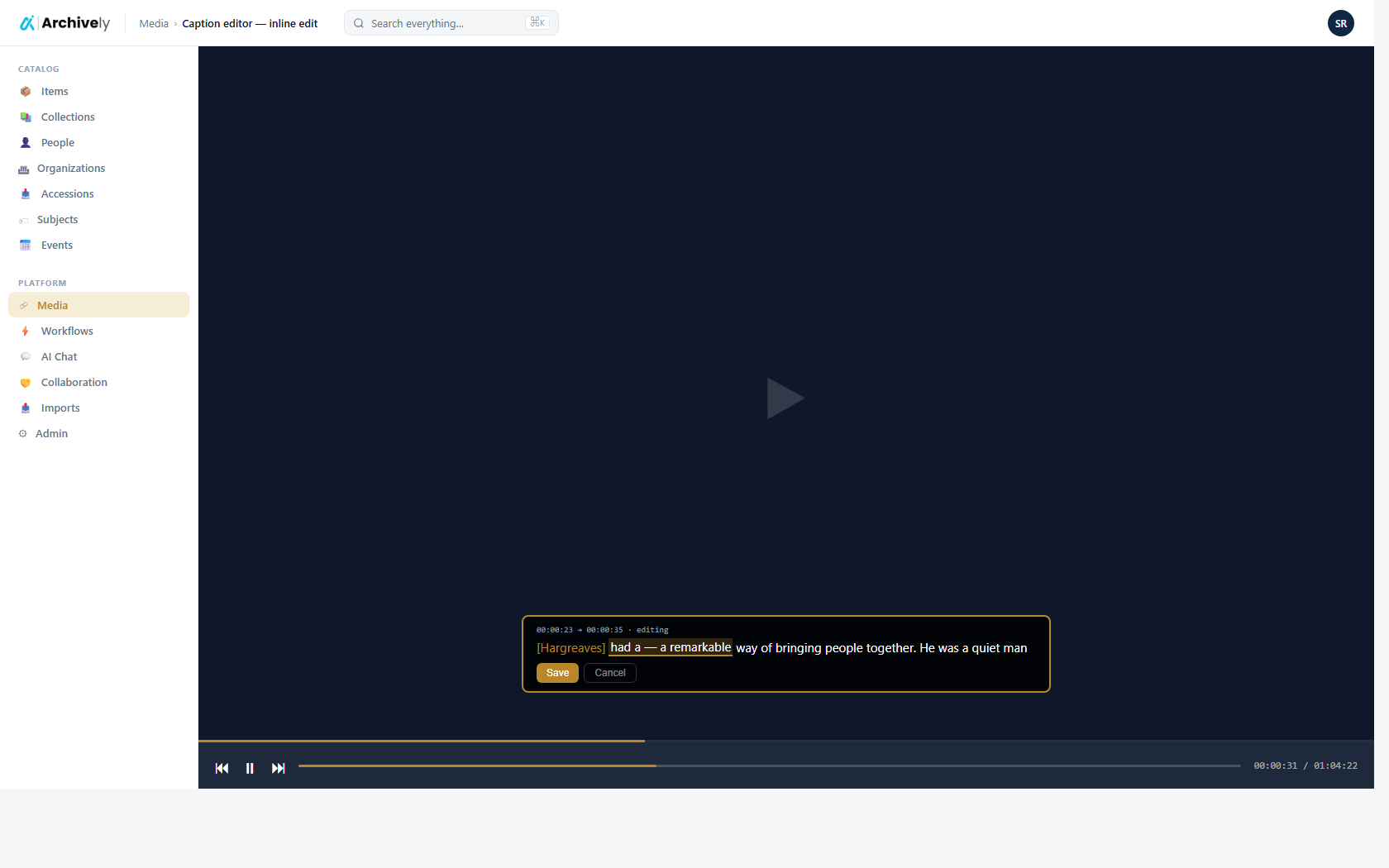
Word-level AI transcription with per-word confidence. A proofreader view to accept, edit, or reject — sentence by sentence — without ever leaving the file.
Crop, deskew, caption in-product.
Archival crop presets, deskew, AI object detection, and archival captions — without leaving the file detail. Every edit lands as a child file with its own provenance.
A branded portal on its own subdomain.
Every tenant gets a public portal at its own subdomain, with six visual templates and four feature flags. EAD2/EAD3 + MODS + EAC-CPF + BagIt exports, OAI-PMH for harvesters, IIIF manifests for external viewers — automatic.
From upload to published finding aid.
Search any entity, let AI fill in the fields, review every change with full diffs, and publish a citable, immutable record — in one continuous workflow.


Watch a record move through the pipeline.
Upload, AI describe, review with diffs, publish. Four stages, one audit trail. This demo cycles the states; you can tap a stage to jump.
- 10:42:08Jane R.Uploaded letter-1919.tif · 3.2 MB · 8 pages

AI drafts. Curators decide. Every edit, remembered.
Three layers — AI output, curator review, and the immutable published snapshot — sit side by side. Inline diffs show exactly what changed; one click reverts or publishes.
An immutable snapshot of what the model produced.
Your working copy, with pristine/dirty tracking.
Signed, dated, and locked. Citable for decades.
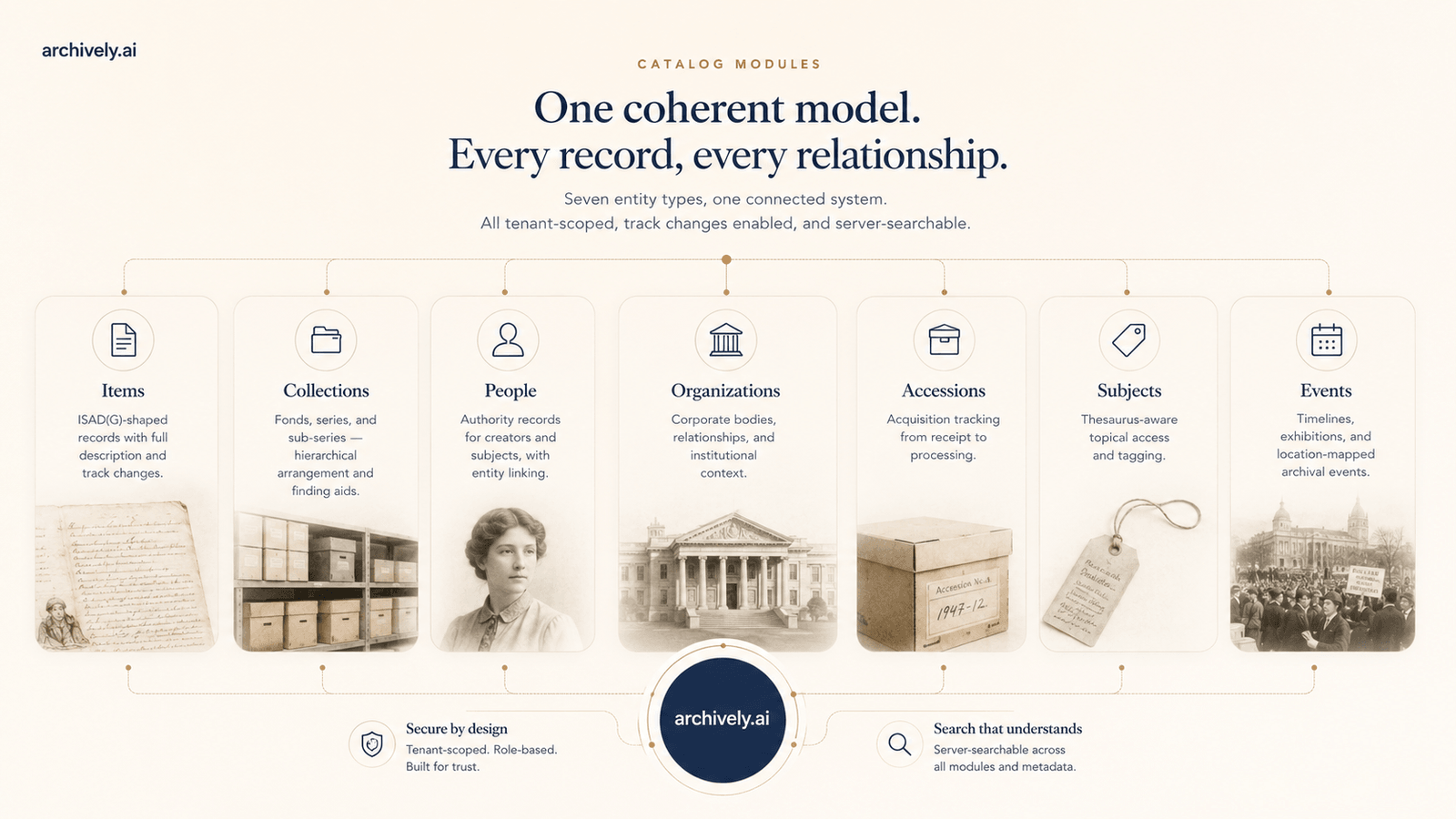
Seven entity types, one coherent model.
All tenant-scoped, track-changes enabled, and server-searchable.
Items
ISAD(G)-shaped records.
Fonds
Hierarchical arrangement.
People
Creator authorities.
Organizations
Corporate bodies.
Accessions
Acquisition tracking.
Subjects
Topical access.
Events
Contextual timelines.
More modules on the roadmap: exhibitions, requests, and reading-room workflow.
See all features →One platform. Fourteen very different institutions.
The data model is the same. The workflows and portals adapt to how your institution actually works.
Libraries, universities, and schools — special collections, oral history centers, and yearbook runs back to founding.
The work the ILS wasn't built for.
Public, academic, and specialist libraries catalog special collections, publish finding aids, and sync with their existing ILS — without forcing manuscripts into bibliographic records.
ExploreOne deployment, many centers.
Institutional archives, oral history centers, and departmental research collections — all on one deployment, each with its own tenancy, branding, and SSO-backed access.
ExploreWhere 137 yearbooks are institutional memory.
Independent schools, boarding schools, and K-12 academies use Archively.AI to bring yearbooks, alumni records, head-of-school correspondence, athletics history, and FERPA-bound student records into one searchable catalog.
ExploreClick a real subdomain. Skip the trial.
Four flagship demo tenants — one per anchor category — running on the same deployment as everyone else. Ten more live alongside.
Northbridge Medical Society Papers
1891 – 1935
Manuscript archive of a fictional provincial medical society, including 1918 pandemic correspondence.
See it →Ridgewood College Oral History Project
1975 – 2015
Audio and video interviews with alumni, faculty, and townspeople — one under embargo.
See it →State Records of Thornwood
1918 – 1925
Public-health records with chain-of-custody, redaction, and PREMIS preservation metadata.
See it →Harbor Museum Archives
1961 – present
Exhibition records, donor histories, and curatorial research files with events as first-class records.
See it →What archivists tell us.
From archivists, records managers, and curators — the people who use this every day.
“We replaced a spreadsheet, a home-grown PHP catalog, and a paid OCR service with one product. The finding aids look better than what we had in print.”
“We can onboard a new research collection in an afternoon instead of a semester. Each department gets the look and workflow they want, on one infrastructure we run centrally.”
“We run it inside our own environment, against our own identity provider, with an audit trail our inspectorate signs off without questions.”
“Our object database has always been well-curated. Our archival side was a mess until now. This gave us parity — at last.”
Ready to retire your legacy cataloging stack?
Spin up a tenant, import a small collection, and see a standards-compliant, AI-described finding aid in an afternoon.
